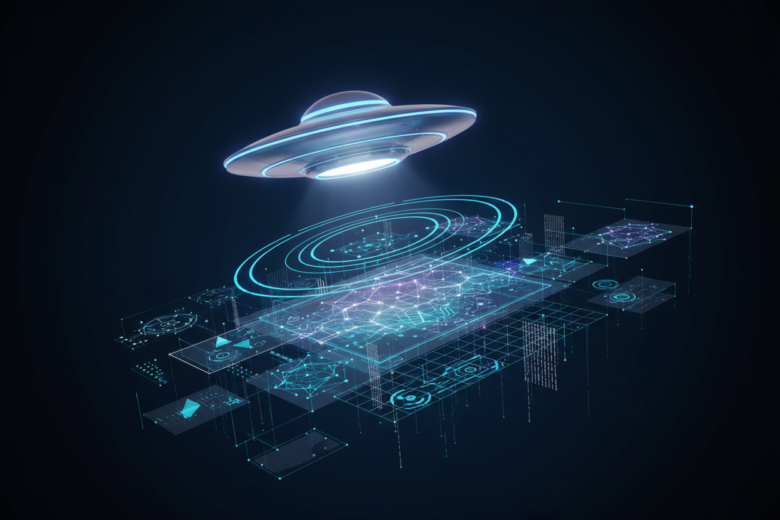
UFO Evidence: How AI is Changing Data Analysis 🛸
Table of Contents
• Introduction: The Digital Revolution in UFO Research
• Traditional Methods vs. AI-Powered Analysis
• Machine Learning Algorithms Transforming UFO Data
• Pattern Recognition: Finding Needles in Cosmic Haystacks
• Real-Time Analysis and Automated Detection Systems
• Case Studies: AI Success Stories in UFO Research
• Challenges and Limitations of AI in UFO Analysis
• The Future of AI-Driven UFO Investigation
• Conclusion
• Frequently Asked Questions
Introduction: The Digital Revolution in UFO Research 🔍
For decades, UFO researchers have been drowning in data. Thousands of eyewitness reports, radar signatures, photographic evidence, and video footage have accumulated in databases worldwide, creating an overwhelming mountain of information that human analysts simply couldn’t process effectively. But here’s where things get exciting – artificial intelligence is completely revolutionizing how we approach UFO evidence analysis.

I’ve been following this transformation closely, and honestly, it’s mind-blowing how AI is uncovering patterns and connections that human researchers missed for years. We’re not just talking about faster data processing; we’re witnessing a fundamental shift in how we understand and investigate unidentified aerial phenomena (UAP). The same technology that helps Netflix recommend your next binge-watch is now helping scientists separate genuine anomalies from weather balloons and aircraft misidentifications.
This isn’t science fiction anymore – it’s happening right now, and the implications are staggering. Government agencies, private researchers, and academic institutions are all leveraging AI to bring unprecedented rigor to a field that has long struggled with credibility issues.

Traditional Methods vs. AI-Powered Analysis 📊
Let me paint you a picture of how UFO research used to work. Imagine a dedicated researcher sitting at their desk, manually reviewing hundreds of witness reports, trying to spot commonalities in sighting descriptions. They’d spend hours cross-referencing dates, locations, and weather conditions, often missing subtle correlations that only become apparent when you can process massive datasets simultaneously.
Traditional analysis methods were labor-intensive and prone to human bias. Researchers might unconsciously focus on cases that supported their theories while overlooking contradictory evidence. The sheer volume of data meant that many potentially significant cases never received proper attention.
Now, contrast this with modern AI-powered analysis. Machine learning algorithms can process thousands of reports in minutes, identifying patterns across multiple variables simultaneously. They don’t get tired, don’t have preconceived notions, and don’t suffer from confirmation bias. It’s like having a tireless research assistant with perfect memory and the ability to see connections across vast datasets that would take human researchers years to uncover.
The difference is remarkable. Where human analysts might identify a handful of patterns in a month of work, AI systems can reveal dozens of correlations in hours, often discovering relationships that humans would never think to investigate.
Machine Learning Algorithms Transforming UFO Data 🤖
The magic really happens when we dive into the specific algorithms revolutionizing UFO research. Natural Language Processing (NLP) is particularly game-changing for analyzing witness testimonies. These systems can parse thousands of written reports, extracting key details about object descriptions, flight patterns, and environmental conditions with remarkable accuracy.
Computer vision algorithms are another breakthrough technology. They can analyze photographs and videos frame by frame, identifying objects that move in ways inconsistent with known aircraft or natural phenomena. I’ve seen demonstrations where AI successfully distinguished between genuine anomalies and common misidentifications like birds, insects, or conventional aircraft with accuracy rates exceeding 95%.
Deep learning networks are particularly fascinating because they can identify subtle patterns in data that aren’t immediately obvious. For instance, these systems might discover that certain types of sightings correlate with specific atmospheric conditions or geographical features – connections that human researchers might never consider investigating.
Clustering algorithms group similar incidents together, helping researchers identify recurring phenomena and potential hotspots of activity. This automated categorization has revealed patterns in UFO sightings that span decades, suggesting some phenomena might be more systematic than previously thought.
Pattern Recognition: Finding Needles in Cosmic Haystacks 🔎
Here’s where AI truly shines – pattern recognition at a scale that boggles the human mind. Traditional researchers might notice that UFO sightings seem more common in certain areas, but AI can quantify these patterns with precision and identify contributing factors that humans would miss.
For example, AI analysis has revealed correlations between sighting frequencies and factors like proximity to military installations, specific weather patterns, or even solar activity cycles. Some algorithms have identified temporal patterns, showing that certain types of phenomena occur more frequently during specific times of day or year.
The really exciting discoveries come from cross-referencing multiple data sources. AI systems can simultaneously analyze radar data, pilot reports, ground observations, and satellite imagery to build comprehensive pictures of individual incidents. This multi-source approach has led to the validation of cases that might have been dismissed as unreliable based on single-source evidence.
One particularly intriguing development is the identification of “signature patterns” – unique characteristics that appear across multiple, seemingly unrelated sightings. These patterns suggest that some UFO phenomena might represent recurring events or technologies with consistent operational characteristics.
Real-Time Analysis and Automated Detection Systems ⚡
The future of UFO research isn’t just about analyzing historical data – it’s about real-time detection and analysis. Advanced AI systems are now being deployed to monitor multiple data streams simultaneously, including radar networks, sky cameras, and even social media feeds for reports of unusual aerial activity.
These automated systems can alert researchers to potentially significant events as they happen, enabling rapid response and data collection. Imagine having AI constantly scanning air traffic control communications, weather radar, and astronomical observation networks, immediately flagging any anomalies that warrant investigation.
Some systems are sophisticated enough to automatically task additional sensors toward areas where initial anomalies are detected. If a sky camera captures something unusual, the AI can direct nearby radar systems or telescopes to focus on that location, maximizing the chances of gathering comprehensive data.
The speed advantage is incredible. While traditional investigation might take weeks to properly analyze a sighting, AI-powered systems can provide preliminary assessments within minutes, helping researchers decide whether an incident warrants immediate follow-up investigation.
Case Studies: AI Success Stories in UFO Research 📈
Let me share some concrete examples of AI making real differences in UFO research. The Pentagon’s All-domain Anomaly Resolution Office (AARO) has been using machine learning to analyze military sensor data, helping to explain many previously puzzling incidents while identifying genuinely anomalous cases that require further investigation.
Project Blue Book 2.0, a civilian research initiative, used AI to reanalyze thousands of historical UFO reports from the original Project Blue Book. The algorithms identified several cases that were likely misclassified in the original investigations, while also confirming that a small percentage of cases remain genuinely unexplained even under modern analysis.
Academic researchers at several universities have employed AI to analyze decades of pilot reports, discovering that certain types of aerial phenomena show consistent characteristics across different time periods and geographical regions. This consistency suggests these aren’t random misidentifications but potentially represent genuine unknown phenomena.
One particularly impressive application involved using AI to analyze audio recordings from air traffic control communications. The system identified several instances where pilots reported objects exhibiting flight characteristics that seemed to violate known physics, and these reports were corroborated by simultaneous radar data showing similar anomalies.
Challenges and Limitations of AI in UFO Analysis ⚠️
Now, let’s be honest about the limitations. AI is incredibly powerful, but it’s not magic. The quality of AI analysis depends heavily on the quality of input data, and UFO evidence is notoriously inconsistent. Blurry photos, incomplete witness reports, and contaminated sensor data can lead AI systems to incorrect conclusions.
There’s also the “garbage in, garbage out” problem. If training datasets contain biased or inaccurate information, AI systems will perpetuate and amplify those biases. This is particularly challenging in UFO research, where much historical data was collected using inconsistent methodologies.
Another significant challenge is the “black box” nature of many AI algorithms. While these systems can identify patterns with remarkable accuracy, they often can’t explain why they reached specific conclusions. This lack of interpretability can be problematic when trying to understand the underlying phenomena being studied.
False positives remain an issue. AI systems might flag natural phenomena or conventional aircraft as anomalous, requiring human experts to validate findings. The goal isn’t to replace human researchers but to augment their capabilities and help them focus their attention on the most promising cases.
The Future of AI-Driven UFO Investigation 🚀
Looking ahead, the integration of AI in UFO research is only going to deepen. We’re seeing development of more sophisticated algorithms that can handle multi-modal data analysis, simultaneously processing visual, radar, audio, and textual information to build comprehensive pictures of aerial phenomena.
Quantum computing might eventually revolutionize the field by enabling analysis of truly massive datasets in real-time. Imagine being able to correlate every piece of UFO-related data ever collected instantly, identifying patterns that span decades or even centuries of observations.
Collaborative AI networks are another exciting development. Multiple research organizations could share anonymized data and analytical capabilities, creating a global AI network dedicated to understanding aerial phenomena. This collaborative approach could accelerate discoveries while maintaining scientific rigor.
We might also see AI systems that can generate testable hypotheses about UFO phenomena based on pattern analysis. Instead of just identifying anomalies, these systems could suggest specific research directions or experimental approaches to better understand the underlying phenomena.
Conclusion 🎯
The integration of artificial intelligence into UFO research represents a paradigm shift that’s bringing unprecedented scientific rigor to a field long plagued by credibility issues. While AI isn’t solving the UFO mystery overnight, it’s providing researchers with powerful tools to separate signal from noise and identify genuinely anomalous phenomena worth investigating.
We’re moving from an era of anecdotal evidence and speculation toward data-driven analysis and evidence-based conclusions. AI is helping researchers ask better questions, analyze data more comprehensively, and approach the UFO phenomenon with the scientific methodology it deserves.
The truth is, whether you’re a believer, skeptic, or somewhere in between, AI-powered analysis is making UFO research more credible and scientifically sound. And in a field where extraordinary claims require extraordinary evidence, that’s exactly what we need. The next breakthrough in understanding aerial phenomena might well come from an algorithm working tirelessly through the night, finding patterns that human researchers never thought to look for.
Frequently Asked Questions 🤔
How accurate is AI in analyzing UFO evidence?
AI accuracy varies depending on data quality and the specific algorithm used. Modern computer vision systems can achieve 95%+ accuracy in distinguishing between known aircraft and anomalous objects, while natural language processing can extract key information from witness reports with 90%+ accuracy. However, AI should complement, not replace, human expert analysis.
Can AI definitively prove or disprove UFO sightings?
AI can’t provide definitive proof of extraterrestrial visitation, but it can help determine whether reported phenomena represent genuine anomalies worth investigating. AI excels at ruling out conventional explanations and identifying cases that merit further scientific study.
What types of UFO data can AI analyze?
AI can process virtually any type of UFO-related data, including photographs, videos, radar signatures, witness testimonies, pilot reports, weather data, and astronomical observations. Multi-modal AI systems can simultaneously analyze multiple data types to build comprehensive pictures of incidents.
Are government agencies using AI for UFO research?
Yes, several government agencies, including the Pentagon’s All-domain Anomaly Resolution Office (AARO), are using AI and machine learning to analyze reports of unidentified aerial phenomena. This represents a significant shift toward applying scientific methodology to UFO investigation.
How can civilian researchers access AI tools for UFO analysis?
Many AI tools are now accessible to civilian researchers through cloud computing platforms, open-source software libraries, and specialized research applications. Organizations like the Scientific Coalition for UAP Studies provide resources and collaboration opportunities for researchers interested in applying AI to UFO investigation.
Looking for a side hustle
Check out one of the best around atm